Friday, February 05, 2010

Playing with the Jena semantic web framework

I've begun tinkering with Jena, a semantic web framework written in Java. It embodies a lot of ideas and technologies that were once considered AI or expert systems, and which I neglected at the time (1980s).
The semantic web frames a body of knowledge as a collection of three-word sentences called triples. These can be diagrammed as a directed graph such as the one below.


The corresponding three-word sentences appear below, written in N3, a human-readable formal language used by the semantic web community.
@prefix :  <#> .
:Cat :has :Fur .
:Bear :has :Fur .
:Cat :is-a :Mammal .
:Bear :is-a :Mammal .
:Mammal :has :Vertebrae .
:Whale :is-a :Mammal .
:Whale :lives-in :Water .
:Mammal :is-a :Animal .
:Fish :is-a :Animal .
:Fish :lives-in :Water .
In Jena, a Model is one of these things. Having constructed it (or having loaded it from either a file on the internet or a file on your computer), you can apply rules that allow you to draw conclusions. So let's step through that proecess. First we need to read in the file.
private static final String baseUri =
    "file:///home/wware/wware-autosci/" +
    "semweb/java/simpleNet.n3#";
private static void modelReadFile(String filename,
                                  Model model) {
    try {
        File f = new File(filename);
        FileReader fr = new FileReader(f);
        model.read(fr, baseUri);
    } catch (FileNotFoundException e) {
        e.printStackTrace();
    }
}
To print the contents of a model, we can use the SPARQL query language, which looks a lot like SQL.
private static void printModel(Model model) {
    String queryString = 
        "SELECT ?x ?y ?z " +
        "WHERE {" +
        "    ?x ?y ?z . " +
        "}";
    Query query = QueryFactory.create(queryString);
    QueryExecution qe =
      QueryExecutionFactory.create(query, model);
    ResultSet results = qe.execSelect();
    ResultSetFormatter.out(System.out, results, query);
    qe.close();
}
and we'll call that method from our main method. I personally find it appalling that the graph above fails to recognize that fish have vertebrae, so we'll add a triple for that.
public static void main(String[] args) {
    Model model = ModelFactory.createDefaultModel();
    modelReadFile("simpleNet.rdf", model);
    model.createResource(baseUri + "Fish")
         .addProperty(model.createProperty(
                         baseUri + "has"),
                      model.createResource(
                         baseUri + "Vertebrae"));
    printModel(model);
}
and the RDF file that imports the model was translated from the N3 above, using CWM.

<rdf:RDF
xmlns="file:///home/wware/wware-autosci/semweb/java/simpleNet.n3#"
xmlns:rdf="http://www.w3.org/1999/02/22-rdf-syntax-ns#">
    <rdf:Description rdf:about="#Bear">
        <has rdf:resource="#Fur"/>
        <is-a rdf:resource="#Mammal"/>
    </rdf:Description>
    <rdf:Description rdf:about="#Cat">
        <has rdf:resource="#Fur"/>
        <is-a rdf:resource="#Mammal"/>
    </rdf:Description>
    <rdf:Description rdf:about="#Fish">
        <is-a rdf:resource="#Animal"/>
        <lives-in rdf:resource="#Water"/>
    </rdf:Description>
    <rdf:Description rdf:about="#Mammal">
        <has rdf:resource="#Vertebrae"/>
        <is-a rdf:resource="#Animal"/>
    </rdf:Description>
    <rdf:Description rdf:about="#Whale">
        <is-a rdf:resource="#Mammal"/>
        <lives-in rdf:resource="#Water"/>
    </rdf:Description>
</rdf:RDF>

There is a Model.write(OutputStream) method, so we can write a model directly to a file instead of stepping through the triples explicitly.

So how about some actual reasoning? We should be able to conclude that a cat is an animal, and has vertebrae. This will require that we define two rules of inference, rule1 ("is-a" is transitive) and rule2 (a member of a species has the things the species has).
String rules =
        "[ rule1: (?x " + baseUri+"is-a ?y) " +
                 "(?y " + baseUri+"is-a ?z) -> " +
                 "(?x " + baseUri+"is-a ?z) ] " +
        "[ rule2: (?x " + baseUri+"is-a ?y) " +
                 "(?y " + baseUri+"has ?z) -> " +
                 "(?x " + baseUri+"has ?z) ]";
Reasoner reasoner = new
    GenericRuleReasoner(Rule.parseRules(rules));
reasoner.setDerivationLogging(true);
InfModel inf =
  ModelFactory.createInfModel(reasoner, model);
printModel(inf);
Simply creating the InfModel is enough to draw all the relevant inferences. The Reasoner's setDerivationLogging method tells the model to remember the derivations that led to any new conclusions, and these derivations can be examined for debugging purposes.
PrintWriter out = new PrintWriter(System.out);
for (StmtIterator i = inf.listStatements();
             i.hasNext(); ) {
    Statement s = i.nextStatement();
    for (Iterator id = inf.getDerivation(s);
             id.hasNext(); ) {
        Derivation deriv = id.next();
        deriv.printTrace(out, true);
    }
}
out.flush();

Wednesday, January 27, 2010

Bayesian nets in RDF, and how to update them

I've banged my head on this for a couple of days and feel close to a solution. The graph looks like this.


Each random boolean variable gets a node, the causal relationship between them gets a node, and each variable gets a probability.
The math for updating probabilities is a little tricky, but in a fun and interesting way, so I enjoyed banging on that. At some point I'll tackle more involved cases where there aren't simply two random boolean variables, but that's the logistically simple case that exposes most of the concepts involved. Kinda like the Drosophila of Bayesian inference.

"""Let A and B be random boolean variables, with A being an
unobservable cause and B being an observable effect, and Pr(B|A) and
Pr(B|~A) are given. This might be the case if the situation has some
structure that dictates the conditional probabilities, like a 6.432
problem, or it just might be empirical.

From these we can compute probabilities for the four cases.
P11 = Pr(B^A) = Pr(A) Pr(B|A)
P10 = Pr(~B^A) = Pr(A) (1-Pr(B|A))
P01 = Pr(B^~A) = (1-Pr(A)) Pr(B|~A)
P00 = Pr(~B^~A) = (1-Pr(A)) (1-Pr(B|~A))

Treat (Pr(B|A), Pr(B|~A)) as one piece of information, and Pr(A) as a
separate independent piece of information. The first piece reflects
your beliefs about the machinery connecting A to B, and the second
reflects your beliefs about the likelihood of A, so these are
legitimately separate concerns.

If we observe that B=1, then we want to replace Pr(A) with our
previous estimate for Pr(A|B), which is given by our old numbers as
P11/Pr(A) = P11/(P11+P01), and this becomes our posterior probability
for A."""

class Link1:
    def __init__(self, PrBgivenA, PrBgivenNotA):
        self.PrBgivenA, self.PrBgivenNotA = PrBgivenA, PrBgivenNotA
    def updatePrA(self, PrA, bvalue):
        p11 = PrA * self.PrBgivenA
        p10 = PrA * (1. - self.PrBgivenA)
        p01 = (1. - PrA) * self.PrBgivenNotA
        p00 = (1. - PrA) * (1. - self.PrBgivenNotA)
        # print p11, p01, p10, p00
        assert 0.999 < p11 + p01 + p10 + p00 < 1.001
        assert PrA - 0.001 < p10 + p11 < PrA + 0.001
        if bvalue:
            # Pr(A|B)
            newPrA = p11 / (p11 + p01)
        else:
            # Pr(A|~B)
            newPrA = p10 / (p10 + p00)
        assert 0.0 <= newPrA <= 1.0
        return newPrA

link = Link1(0.6, 0.27)

PrA = 0.5
print PrA

for i in range(5):
    PrA = link.updatePrA(PrA, 0)
    print PrA

for i in range(10):
    PrA = link.updatePrA(PrA, 1)
    print PrA

Monday, January 18, 2010

Inference engines and automated reasoning

An inference engine is a computer program that reasons, using some form of knowledge representation.

This can be done with propositional logic or first-order logic, assuming each proposition is completely unambiguous and is either 100% true or 100% false. These simplistic engines are fun little exercises in programming but in real-world situations, reasoning usually needs to consider ambiguities and uncertainties. Instead of simply being true or false, propositions may be likely or unlikely, or their likelihood may be something to be tested or determined. Some elements of some propositions may be poorly defined.

In the unambiguous binary case, it's typical to express rules for generating new propositions as if-then rules with variables in them. We call these production rules because they are used to produce new propositions.
If X is a man, then X is mortal.
Given the statement "Socrates is a man", we
  • match the statement to the rule's IF clause
  • take note of all variable assignments: X=Socrates
  • plug assignments into the THEN clause: "Socrates is mortal"
Obviously this isn't rocket science, but even without handling uncertainty, it will still be useful if scaled to very large numbers of propositions, as in the semantic web.

How to handle uncertainty? This can be done by representing knowledge as a Bayesian network, a directed graph where the edges represent the influences and dependencies between random variables. There is a good tutorial about these online. Here's an example from the Wikipedia article where the probability of rain is an independent variable, and the sprinkler system is usually off if it's raining, and the grass can get wet from either rain or the sprinkler.

There are at least two open-source inference engines that work with Bayesian networks. One is SMILE, another is the OpenBayes library for the Python language. OpenBayes allows you to update the state of your knowledge with a new observation.
Suppose now that you know that the sprinkler is on and that it is not cloudy, and you wonder what's the probability of the grass being wet : Pr(w|s=1,c=0). This is called evidence...
ie.SetObs({'s':1,'c':0})
and then perform inference in the same way... The grass is much more likely to be wet because the sprinkler is on!
Here is a list of many more Bayesian network libraries, and another list. There is also a nice tutorial on Learning Bayesian Networks from Data, the process of taking a bunch of data and automatically discovering the Bayesian network that might have produced it. Another Bayesian reasoning system is BLOG.
Bayesian logic (BLOG) is a first-order probabilistic modeling language under development at MIT and UC Berkeley. It is designed for making inferences about real-world objects that underlie some observed data: for instance, tracking multiple people in a video sequence, or identifying repeated mentions of people and organizations in a set of text documents. BLOG makes it (relatively) easy to represent uncertainty about the number of underlying objects and the mapping between objects and observations.
Are production rule systems and Bayesian network systems mutually compatible? I don't yet know. Do Bayesian networks adequately represent all important forms of uncertainty or vagueness that one might encounter in working with real-world data? I don't know that either. Are there other paradigms I should be checking out? Probably.

Sunday, January 17, 2010

How hard is generating scientific hypotheses?

In the 1500s, a Danish astronomer named Tycho Brahe used Galileo's invention of the telescope to collect an enormous amount of numerical data describing the motion of the planets. Brahe's assistant Johannes Kepler studied that data and arrived at some interesting conclusions which we now know as Kepler's laws of planetary motion:
  1. The orbit of every planet is an ellipse with the Sun at a focus.
  2. A line joining a planet and the Sun sweeps out equal areas during equal intervals of time.
  3. The square of the orbital period of a planet is directly proportional to the cube of the semi-major axis of its orbit.
Kepler's laws were the starting point from which Isaac Newton formulated his law of gravitation, the inverse-square law that we all know and love.

We have here a three-step process: collect data, find mathematical patterns in the data, and create a theory that explains those patterns. Collecting data is simple in principle, and looking for mathematical patterns is also simple. Kepler's arithmetic was done by hand, but now we have computer programs (like Eureqa) which use genetic programming to find parsimonious mathematical formulas that fit sets of data. You can find Java applets on the web that demonstrate this idea.

So the first two steps aren't too hard. We can arrive rather easily at mathematical formulas that describe various experimentally measurable aspects of reality. That's a good thing. The hard job is the next step: finding theories or "likely stories" that explain why those formulas take whatever form they do. Sometimes the form of the math suggests a mechanism, because you've learned to associate elliptical orbits with conservative force fields which necessarily have an inverse-square law. (Hundreds of years after Newton, that is now a no-brainer.) But generally the problem is non-trivial and so far, as far as I'm aware, requires human insight.

Foresight Institute conference, Jan 16 and 17, 2010

The Foresight conference is just winding down. The talks were live-blogged over at NextBigFuture by Brian Wang who did a good job of concisely capturing the essentials. My own favorite talk was by Hod Lipson, who talked about a number of things, including something I find fascinating, the automation of science, about which I plan to blog more frequently.

I blogged too briefly in the past about the Adam project, but it deserves more. Reported in April 2009 by Ross King at Aberystwyth University. It used lab automation to perform experiments, and data mining to find patterns in the resulting data. Adam developed novel genomics hypotheses about S. cerevisiae yeast and tested them. Adam's conclusions were manually confirmed by human experimenters, and found to be correct. This was the first instance in human history where a machine discovered new scientific knowledge without human oversight.

Here is what I want to see computers doing in the coming years.
  • Look for patterns in data -- data mining
  • Propose falsifiable hypotheses
  • Design experiments to test those hypotheses
  • Perform the experiments and collect data
  • Confirm or deny hypotheses
  • Mine new data for new patterns, repeat the process
In the longer term, I want to see machine theoreticians and experimetalists collaborate with their human counterparts, both working in a scientific literature that is readable and comprehensible for both. This will require the development of a machine-parseable ontology (ideally a widely recognized standard) for sharing elements of the scientific reasoning process: data sets, hypotheses, predictions, deduction, induction, statistical inference, and the design of experiments.

So why do I want all this stuff? For one thing, it's interesting. For another, I am approaching the end of my life and I want to see scientific progress (and particularly medical progress) accelerate considerably in my remaining years. Finally, this looks to me like something where I can make some modestly valuable contribution to humanity with the time and energy I have left.

Sunday, December 20, 2009

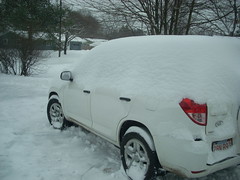
Snow and more snow, December 2009

We got a dusting on December 6th.

In all this cold, I had occasion to heat some water for tea, watching the pot the whole while, and contrary to common belief, it boiled anyway.

We had a bunch of snow last night and this morning. It's just stopped in the last hour.
dscn0530 dscn0531

Wednesday, December 02, 2009

Honorable mention for BetterExplained.com website and its author, Kalid Azad

Kalid Azad's BetterExplained.com website has a lot of elegantly straightforward articles on interesting topics, many of them mathematical. He's doing some really interesting stuff, including a brilliant online calculator that you can use to embed calculations in web pages.

I'm not a Microsoft fanboy by any means, but I admire the video he made, using Windows 7 for humanitarian purposes.

In an article on happiness, Kalid includes a video of Steve Jobs's commencement address at Stanford. I'm really grateful that he included this.

Remember this is a guy who had a diagnosis of terminal cancer a year earlier.
Your work is going to fill a large part of your life, and the only way to be truly satisfied is to do what you believe is great work. And the only way to do great work is to love what you do. If you haven't found it yet, keep looking. Don't settle... All external expectations, all pride, all fear of embarrassment or failure -- these things just fall away in the face of death, leaving only what is truly important. Remembering that you are going to die is the best way I know to avoid the trap of thinking you have something to lose. You are already naked. There is no reason not to follow your heart.
I recently left a job where I wasn't following my heart. The money was good and the rest of the economy was bad, so I spent a lot of energy and effort trying to make it work, but there was no passion or fun or excitement. So this talk resonates for me now.

Tuesday, November 24, 2009

A few last comments on the Hackathon

This is a random collection of notes about things I learned at the Hackathon or shortly after.

The Hackathon was a lot of fun. Pamela Fox, one of the developers of Wave, gave a couple of presentations (1, 2).

There are some article on debugging Wave extensions for Robots and Gadgets. More handy debug tips here.

If you're writing a Robot in Java, a huge amount of support is available in Google's Eclipse plugins. Be sure to have Java 1.6 installed. If you already have an earlier version, you can install 1.6 on top of it, and just switch the preference within Eclipse. I think it was Windows -> Preferences -> Java -> something...

There is also an Eclipse plugin for Python called PyDev. I don't have a lot of experience with it.

One guy at the Hackathon wrote a robot in Groovy, a dynamic language that runs on the JVM. From what I could tell, it was working fine.

At the present time, Robots must be deployed to Google App Engine. This restriction will probably be relaxed, especially as non-Google Wave servers come on line.

App Engine doesn't run PHP (I had wanted to add Mediawiki to my web app) but if you really want PHP you can try Quercus.

App Engine has a great logging facility, accessible via https://appengine.google.com. You can put logging statements in Python code (import logging) or Java code (import java.util.logging) and both will dump info statements into the GAE log.

Google likes extensions to adhere to some design principles. These are designed to maximize the broad appeal of your Wave extension and to make it run faster. Google figures that slow ugly extensions will drive users away from their ads.

There was talk at the Hackathon (and I wasn't paying close enough attention) about people setting up Wave servers. If I set up my own server, can I issue my own invitations to people so that I'm not depending on Google providing invitations? That would rock.

More useful links:
Something that would be very valuable for robot development would be a lightweight Wave server simulator running in Python, probably using the classes in the Python Wave API. You'd want a way to simulate an on-going Wave conversation, and the simulator would send events to the robot.

Monday, November 16, 2009

Tinkering with Google Wave Gadgets and Robots

Google is hosting a Hackathon on Saturday focusing on Wave. For Wave, you can create Gadgets or Robots. I wanted to be able to monitor and control my house's non-existent burglar alarm and X10 appliances from inside a Wave. A Gadget is the best thing for that, which you'll see (entitled "Home Controller") on the right side of this blog.

Assuming my machine at home is running the client code (which doesn't really control anything, it just fakes it), you can use the command "feed the cat" with password "abcd" to change the cat's state from hungry to full, or "wait a minute" to change the cat from full to hungry. Be patient, it can take up to fifteen seconds before your command produces a visible result. The Gadget and the client code are both polling a teeny web service on App Engine which passes information between them, and the polling rate is not hasty. The Gadget's source is hosted on Google Code. A not-too-detailed description is here.

Robots require working directly with the Wave API, which Gadgets don't. Here is a Robot that will help you look stuff up in the Linux kernel source code, using the LXR website. To use the Robot in a wave, first add it to your Gmail contacts. Use the name "Lxreffy" and the email address "wware-lxreffy@appspot.com". Now go into Wave and search for the contact "Lxreffy", and you'll be able to invite it into any Wave. Then type "LXR: foobar" in a blip, and hit "Done", and it will append a series of web links to the blip showing where "foobar" appears in the kernel. Example screenshot below.


Another Robot uses SymPy to enable symbolic algebra to be done within a Wave. The "SymPy { ... }" piece is typed by the human user, and the Robot responds by adding the response from SymPy.


Rosie คือโปรแกรมคอมพิวเตอร์สำหรับการแปลภาษามนุษย์เขียนโดย Google. ลักษณะที่ฉันชอบไม่ได้งานดีมาก. ฉันจะใส่ข้อความภาษาไทยนี้บนบล็อกของฉัน.

Monday, October 12, 2009

Hacking CUDA and OpenCL on Fedora 10

I discovered Fedora 11 is not compatible with NVIDIA's CUDA toolkit (now on version 2.3; see note about driver version below) because the latter requires GCC 4.3 where Fedora 11 provides GCC 4.4. So I'll have to back down to Fedora 10. Here are some handy notes for setting up Fedora 10. I installed a number of RPMs to get CUDA to build.
sudo yum install eclipse-jdt eclipse-cdt \
freeglut freeglut-devel kernel-devel \
mesa-libGLU-devel libXmu-devel libXi-devel

The Eclipse stuff wasn't all necessary for CUDA but I wanted it.

In a comment to an earlier posting, Jesper told me about OpenCL, a framework for writing programs that execute across heterogeneous platforms consisting of CPUs, GPUs, and other processors. NVIDIA supports this and has an OpenCL implementation which required updating my NVIDIA drivers to version 190.29, more recent than the version 190.18 drivers on NVIDIA's CUDA 2.3 page. When I installed 190.29, it warned me that it was uninstalling the 190.18 drivers.

Python enthusiasts will be interested in PyOpenCL.

NVIDIA provides a lot of resources and literature for getting started with OpenCL.

Friday, October 09, 2009

Sampled profiling in Linux

A few years back I was doing some cross-platform work on a mostly-Python package with a bunch of math libraries. I happened to be jumping back and forth between Linux and Mac, and I discovered that the Mac had this magical performance measurement tool that, as far as I knew, didn't exist for Linux. How could that be? How could such a great idea, obviously amenable to open source, NOT have made it into the Linux world? I was flabbergasted.

That tool was a sampling profiler. It works like this. At regular intervals, you stop the processor and say, what are you doing? what process are you in? what thread are you in? what does your call stack look like? and you collect statistics on all this stuff, figure out the percentages of time spent in different places, and present it in an easily understandable visual tree format.

Thinking about it more, I saw that to make this work, you need to have built your code with debug enabled, so that all the symbols are present in the compiled binary. Most Linux software is built without debug symbols (or at least that was the common practice a few years ago) which is why this idea hadn't gotten traction in the Linux world.

So today I stumbled across a cool review of Fedora 11 Linux and near the bottom, it talks about some of the development work that Red Hat has been doing on the Eclipse IDE, including a sampling profiler called OProfile. There's a nice little video of a Red Hat engineer demonstrating OProfile. Very cool stuff. One of the most impressive things is that in addition to simply sampling at fixed time intervals, you can also choose to sample on events happening in the computer hardware, like when the processor drives data onto the front-side bus. Wow, yikes. I don't have a clear idea what that would help with, but I guess some performance issues can correlate to things happening in the hardware.

Here are some of my old notes I found on this topic. These notes are old and I didn't know about OProfile at the time, though OProfile originated in the same group at HP that did the QProf work described below. The old notes will be in italics to avoid confusion with more current information.

Finally, something the Mac has that Linux doesn't have

The Mac has this cool little utility called sample. Here's how it works. Suppose some program is running as process ID 1234. You type "sample 1234 60" in another terminal, and it interrupts that process 100 times per second for 60 seconds, getting a stack trace each time. You end up with a histogram showing the different threads and C call stacks, and it becomes very easy to figure out where the program is spending most of its time. It's very cool. It doesn't even significantly slow down the process under study.

I started looking to see if there was anything similar for Linux. There ought to be. This isn't so different from what GDB does. The closest thing I could find was something called pstack, which does this once, but doesn't seem so good at extracting the names of C routines. I've never seen pstack get a stack that was more than three calls deep. I also found a variant called lsstack.

I think the Mac can do this because Apple can dictate that every compile must have the -g switch turned on. The pstack utility came originally from the BSD world.

If there's ever a working sample utility for Linux, it will be a brilliant thing.

First you need a timer process that interrupts the target process. On each interrupt, you collect a stack trace. You do that by having an interrupt handler that gets the stack above it and throws it in some kind of data structure. In Mac OS, you can do all this without recompiling any of the target process code.

You run the timer for however long and collect all this stuff. You end up with a data structure with all these stacks in it. Now you can create a tree with histogram numbers for each node in the tree, where each node in the tree represents a program counter. Next you use map files to convert the program counters to line numbers in source files, and if you want brownie points, you even include the source line for each of them.

This should be feasible in Linux. Check out "man request_irq".

The only issue with making this work as well in Linux as it does on the Mac is that code that isn't built with "-g" will not have the debug information for pulling out function names and line numbers. Somebody (probably David Mosberger-Tang) has already done this project:

Tuesday, August 25, 2009

I blinked, and web apps advanced ten years

Back in the day, we all watched static HTML pages give way to CGI, followed by MySQL and Perl, followed by Java middleware. Back then I wrote NanoCAD, but client-side Java applets never got traction. Now we have Flash and Silverlight and AJAX. On the server side we have PHP, and on the client side, Javascript, which is totally unrelated to Java. Many modern browsers now support the canvas tag. Kinda makes me want to recast NanoCAD in more modern technology.

Simultaneously we now have netbooks - small cheap wifi-connected laptops that can run a decent web browser and not much more. Google and others are pitching the idea that all our previously shrink-wrapped apps can therefore live in the cloud. It's an intriguing idea.
When you're working in Java or Python, you can use an IDE like Idea or Idle. Is there anything like that for Javascript? I am not aware of it, if there is.

Tuesday, July 21, 2009

Building a GPU machine

I've been reading lately about what NVIDIA has been doing with CUDA and it's quite impressive. CUDA is a programming environment for their GPU boards, available for Windows, Linux, and Mac. I am putting together a Linux box with an NVIDIA 9600GT board to play with this stuff. The NVIDIA board cost me $150 at Staples. Eventually I intend to replace it with a GTX280 or GTX285, which both have 240 processor cores to the 9600GT's 64. I purchased the following from Magic Micro, which was about $300 including shipping:
Intel Barebones #2


* Intel Pentium Dual Core E2220 2.4 GHz, 800FSB (Dual Core) 1024K
* Spire Socket 775 Intel fan
* ASRock 4Core1600, G31, 1600FSB, Onboard Video, PCI Express, Sound, LAN
* 4GB (2x2GB) PC6400 DDR2 800 Dual Channel
* AC 97 3D Full Duplex sound card (onboard)
* Ethernet network adapter (onboard)
* Nikao Black Neon ATX Case w/side window & front USB
* Okia 550W ATX Power Supply w/ 6pin PCI-E


I scavenged an old DVD-ROM drive and a 120-gig HD from an old machine, plus a keyboard, mouse, and 1024x768 LCD monitor. I installed Slackware Linux. I went to the CUDA download website and picked up the driver, the toolkit, the SDK, and the debugger.

This is the most powerful PC I've ever put together, and it was a total investment of just a few hundred dollars. For many years I've drooled at the prospect of networking a number of Linux boxes and using them for scientific computation, but now I can do it all in one box. It's a real live supercomputer sitting on my table, and it's affordable.

I am really starting to like NVIDIA. They provide a lot of support for scientific computation. They are very good about sharing their knowledge. They post lots of videos of scientific uses for their hardware.
NVIDIA's SDK includes several demos, some of them visually attractive: n-body, smoke particles, a Julia set, and a fluid dynamics demo. When running the n-body demo, the 9600GT claims to be going at 125 gigaflops.
A few more resources...

Friday, July 10, 2009

Moore's Law and GPUs

Way back when, Gordon Moore of Intel came up with his "law" that the number of transistors on a given area of silicon would double every 18 months. Currently chip manufacturers use a 45 nm process, and are preparing to move to a 32 nm process. There is an International Technology Roadmap for Semiconductors that lays all this out. As feature sizes shrink, we need progressively more exotic technology to fabricate chips. The ITRS timeframe for a 16 nm process is 2018, well beyond the expectation set by Moore's Law. There is a lot of punditry around these days about how Moore's Law is slowing down.

That's process technology. The other way to improve computer performance is processor architecture. As advances in process technology become more expensive and less frequent, architecture plays an increasingly important role. It's always been important, and in the last 20 years, microprocessors have taken on innovations that had previously appeared only in big iron, things like microcode, RISC, pipelining, cacheing of instructions and data, and branch prediction.

Every time process technology hits a bump in the road, it's a boost for parallelism. In the 1980s, a lot of start-ups tried to build massively parallel computers. I was a fan of Thinking Machines in Cambridge, having read Danny Hillis's PhD thesis. The premise of these machines was to make thousands of processors, individually fairly feeble, arranged in a broadcast architecture. The Transputer chip was another effort in a similar direction. One issue then was that people wanted compilers that would automatically parallelize code written for serial processors, but that turned out to be an intractable problem.

Given the slowing of Moore's Law these days, it's good to be a GPU manufacturer. The GPU guys never claim to offer a parallelizing compiler -- one that can be applied to existing code written for a serial computer -- instead they just make it very easy to write new parallel code. Take a look at nVIDIA's GPU Gems, and notice there's a lot of math and very little code. Because you write GPU code in plain old C, they don't need to spend a lot of ink explaining a lot of wierd syntax.

Meanwhile the scientific community has realized over the last five years that despite the unsavory association with video games, GPUs are nowadays the most bang for your buck available in commodity computing hardware. Reading about nVIDIA's CUDA technology just makes me drool. The claims are that for scientific computation, an inexpensive GPU represents a speed-up of 20x to 100x over a typical CPU.

When I set out to write this, GPUs seemed to me like the historically inevitable next step. Having now recalled some of the earlier pendulum swings between process technology and processor architecture, I see that would be an overstatement of the case. But certainly GPU architecture and development will be important for those of us whose retirements are yet a few years off.

Wednesday, June 24, 2009

Whole-cell simulation

E-Cell is a software model of a biological cell. To use E-Cell (as it existed in its initial incarnation), you define a set of DNA sequences and chemical reactions, and the program iterates them over time, tracking the concentrations of different proteins and other goings-on in the cell.

That's very cool, but it does require you to tell it what kinds of reactions are possible, and their relative likelihoods. What you get out is concentrations, not information about individual protein molecules. That approach doesn't know the shapes of molecules, or anything detailed about how the molecules interact.

E-Cell later evolved into an umbrella project that encompasses several different simulation subprojects, all with the goal of simulating an entire biological cell. So this isn't a limitation of E-Cell per se, just that particular simulation approach.

At the extreme end, one could imagine a full-blown molecular dynamics simulation of every atom in the cell. That would be great but for two problems. First, it would require a horrendous amount of computation. Cells have something like 1015 atoms in them, and molecular dynamics simulations typically have time steps in the femtoseconds, where cellular activities frequently take place over tens of minutes.

The second problem is making sense of the forest amid the trees. You're tracking every atom, but you're really curious about membranes and DNA and mitochondria and all those interesting little structures inside the cell. The computer needs to realize that this particular collection of atoms is a ribosome in this orientation, transcribing this particular base pair and grabbing that particular amino acid. So in addition to this monstrously impossible simulation, there are some tough problems in pattern recognition.

Nevertheless I hold out hope that whole-cell simulation on a scale considerably more detailed than E-Cell is still a worthwhile goal. I suspect that there is some middle road of simulation detail. Perhaps molecules and cell structures can be represented with rigid body mechanics, with surface representations of electric charge and other attractive and repulsive forces. Some are fairly rigid, but the mooshier ones can be represented by finite element models.

Why bother with whole-cell simulation? What can it do for humanity, or for you in particular? If a half-decent simulation could run on a single desktop computer (or maybe a small number of desktop computers) it would allow large numbers of researchers and hobbyists to perform biological experiments in silico. It might advance medical science quite rapidly. It might bring about cures for diseases that are currently untreatable. At the least it would provide a lot of educational opportunities that wouldn't otherwise exist.

Cool robot videos


Willow Garage is a Bay area robot company working on a platform intended to make it easier to build little robots for research and household use. There's a nice writeup about them on Foresight's website.
They are oriented to making an impact on the field of robotics rather than making an immediate profit. Cousins explained it in these terms: the average robotics PhD student spends 90% of his time building a robot and the remaining 10% extending the state of the art. If Willow Garage succeeds, those numbers will be reversed.
Neat. I'd love to get a chance to play with one.

Friday, May 29, 2009

Molecular modeling with Hadoop?

Hadoop is Apache's implementation of the MapReduce distributed computing scheme innovated by Google. Amazon rents out Hadoop services on their cluster. It's fairly straightforward to set up Hadoop on a cluster of Linux boxes. Having myself a long-standing interest in distributed computing approaches to molecular modeling, I have been trying to figure out how Hadoop could be applied to do very large-scale molecular simulations.

MapReduce is great for problems where large chunks of computation can be done in isolation. The difficulty with molecular modeling is that every atom is pushing or pulling on every other atom on every single time step. The problem doesn't nicely partition into large isolated chunks. One could run a MapReduce cycle on each time step, but that would be horribly inefficient - on each time step, every map job needs as input the position and velocity of every atom in the entire simulation.

There are existing solutions like NAMD, which uses DPMTA for the long-range forces between atoms. For a cluster of limited size these are the appropriate tools. For large clusters with hundreds or thousands of machines, the rate of hardware failures becomes a consideration that can't be ignored.

MapReduce provides a few principles for working in the very-large-cluster domain:
  • Let your infrastructure handle hardware failures, just like the way the Internet invisibly routes around dead servers.
  • Individual machines are anonymous. You never write application code that directly addressses an individual machine.
  • Don't waste too much money trying to make the hardware more reliable. It won't pay off in the end.
  • Use a distributed file system that reliably retains the inputs to a task until that task has been successfully completed.

Could the tasks that NAMD assigns to each machine be anonymized with respect to which machine they run on, and the communications routed through a distributed filesystem like Hadoop's HDFS? Certainly it's possible in principle. Whether I'll be able to make any reasonable progress on it in my abundant spare time is another matter.

Thursday, May 28, 2009

More thinking about compensation models

I've been watching some of The Hunt for Gollum. The quality is quite good, and some of the camera effects are surprisingly clever.

I am interested in the question, how do you release a work so that it ultimately ends up in the public domain, but first make some money (perhaps a lot)? And how do you do this when your customer base is entirely aware that, in the long run, it will be available for free?

Back in the Eighties, Borland sold their Turbo Pascal development system for only $30 when competing products sold for hundreds, and did nothing in hardware or software to implement any sort of copy protection, while their competitors scrambled for complicated but unsuccessful approaches to combat piracy. Borland's approach to copy protection was simply the honor system, and making the product cheap enough that nobody minded paying for it.

The machinima Red vs. Blue is released serially as episodes. Those guys have an interesting approach:
Members of the official website can gain sponsor status for a fee of US$10 every six months. Sponsors can access videos a few days before the general public release, download higher-resolution versions of the episodes, and access special content released only to sponsors. For example, during season 5, Rooster Teeth began to release directors' commentary to sponsors for download. Additionally, while the public archive is limited to rotating sets of videos, sponsors can access content from previous seasons at any time.
They are smart guys who have been doing this for years now, so it's likely they've hit upon as optimal a solution as is practical. Of course it helps that they have a great product that attracts a lot of interest. They are following the Borland approach: sponsorship is inexpensive and there is no attempt at copy protection.

Computer performance vibes

There are a number of topics pertaining to computer performance that I want to learn more about. As an ex-EE, I should be keeping up with this stuff better.

Processors are fast, memory chips are slow. We put a cache between them so that the processor need not go out to memory on every read and write. There is a dense body of thought about cache design and optimization. I might blog about this stuff in future. It's a kinda heavy topic.

One way to make processors run really fast is to arrange steps in a pipeline. The CPU reads instruction one from instruction memory, and then it needs to read something from data memory, do an arithmetic operation on it, and put the result in a register. While reading from data memory, the CPU is simultaneously reading instruction two. While doing arithmetic, it's reading instruction three, and also doing the memory read for instruction two. And so forth, so that the processor is chopped up into a sequence of sub-processors, each busy all the time.


Apple has a nice, more detailed discussion, here.
But there is a complication with pipelining. Some of these instructions are branch instructions, which means that the next instruction could be either of two different ones. That's potentially a mess, because you've already got the pipeline full of stuff when you discover whether or not you're taking the branch, and you might find that the instructions you fetched were the wrong ones, so you have to go back and do all those same operations with a different sequence of instructions. Ick.
The work-around is branch prediction. The CPU tries to figure out, as accurately as it can, which sequence it will end up going down, and if all goes well, does that early enough to fill the pipeline correctly the first time. It doesn't have to be perfect, but it should try to guess correctly as often as possible.
A couple more things they're doing these days. One is to perform several memory transfers per cycle. Another is something Intel calls hyper-threading, where some of the CPU's registers are duplicated, allowing it to behave like two separate CPUs. This can be a win if one half is stalled waiting for a memory access; the other half just plows ahead.
That's all the vaguely intelligent stuff I have to say on this topic at the moment. Maybe I'll go into more detail in future, no promises.

Friday, May 01, 2009

Fan-made movie: The Hunt for Gollum

The Hunt for Gollum is a 40-minute high-def movie made by fans of the Lord of the Rings trilogy in general, and the Peter Jackson movies in particular. The trailers look beautiful, the cinematography looks about as good as the three movies. This is being done on a purely non-profit basis and the entire movie will be released free to the Internet on Sunday, May 3rd.

I kinda wish these guys had tried to make money with this, for a few reasons. First, they should be rewarded for such a monumental effort. No doubt many of the primary organizers will get their pick of sweet jobs, just as the primary developers of Apache, Linux, Python, etc. have gone on to sweet jobs after releasing useful free software, but other participants might have gotten some compensation for their time and effort.

Second, there was an opportunity here to experiment with compensation models whose endgame is the release of a work into the public domain. I've often wondered if a big movie could be made by an independent group and released to the public domain, and still bring in significant money. My first idea for a ransom model where each frame of the movie would be encrypted and distributed, and encryption keys for frames or groups of frames would be published as various amounts of the total desired donation were reached. There would probably be a clause that the entire key set would be released unconditionally at some future date.

I think I have a better idea on further reflection. Before the public-domain release, find some buyers who are willing to pay for the privilege of having the movie before the big release. The buyers need to be informed that a public-domain release will occur and on what date, so that they understand that the window to make any money off the movie will be limited.

Another possibility is a ransom model with a linearly-decreasing donation threshold, with the public-domain release scheduled for when the donation threshold reaches zero. If the total donations cross the threshold before then, the release occurs at that time.

Anyway, kudos to the people who made "Hunt for Gollum", thanks for your efforts, and I am eagerly looking forward to seeing the movie.

Wednesday, April 22, 2009

Machines doing actual science, not just lab work

Here's the press release: Robot scientist becomes first machine to discover new scientific knowledge

In an earlier posting, I discussed the idea of computers participating in the reasoning process of the scientific method. There are, as far as I can see, two fields that are applicable to this. One is machine learning, where a computer studies a body of data to find patterns in it. When done with statistical methods, this is called data mining. The other is automated reasoning such as is done with semantic web technology.

So I was quite interested to see the news story linked above. Researchers in the UK have connected a computer to some lab robotics and developed a system that was able to generate new scientific hypotheses about yeast metabolism, and then design and perform experiments to confirm the hypotheses.

This is important because there will always be limits to what human science can accomplish. Humans are limited in their ability to do research, requiring breaks, sleep, and vacations. Humans are limited in their ability to collaborate, because of personality conflicts, politics, and conflicting financial interests. Human talent and intelligence are limited; the Earth is not crawling with Einsteins and Feynmans.

That's obviously not to say that computers would have an unlimited capacity to do science. But their limits would be different, and their areas of strength would be different, and science as a combined effort between humans and computers would be richer and more fruitful than either alone.

I still think it's important to establish specifications for distributing this effort geographically. I would imagine it makes sense to build this stuff on top of semantic web protocols.

I like the idea that with computer assistance, scientific and medical progress might greatly accelerate, curing diseases (hopefully including aging) and offering solutions to perennial social problems like boom-and-bust economic cycles. Then we could all live in a sci-fi paradise.

Tuesday, April 21, 2009

Obama talks about trains

I voted for Obama. It's great that he's the first black president, but it's not the most important thing to me. It's gratifying that he represents a big change from the previous administration. But for me, the real thing with Obama is, every time I hear him talk, he sounds like he's actually thinking. You sometimes see him pausing to think during press conferences. It's been so long overdue to have somebody in the White House who can sustain a thought process. So every time I hear him talk, I get another little bump of good feeling about him. Thank goodness he shares so many of my values; in the other camp he'd be a significant danger.

I don't know whether his economic policies will succeed. I hope so.
The credit belongs to the man who is actually in the arena, whose face is marred by dust and sweat and blood; who strives valiantly; who errs, who comes short again and again, because there is no effort without error and shortcoming; but who does actually strive to do the deeds; who knows great enthusiasms, the great devotions; who spends himself in a worthy cause; who at the best knows in the end the triumph of high achievement, and who at the worst, if he fails, at least fails while daring greatly, so that his place shall never be with those cold and timid souls who neither know victory nor defeat.
— Theodore Roosevelt
Alright, enough gushing. But I really do love having this guy as my president.


A few days ago, Obama and Biden presented a vision of the future of railroads in America. I think it's pretty damn cool. I live in the Northeast Corridor where train service is the best in the country, and I haven't taken the train anywhere since college thirty-mumble years ago. I'm not a big train enthusiast. But I think this is the kind of thing that can stimulate national enthusiasm, not in a trivial meaningless way, but toward a goal that creates jobs and opportunities for new businesses that create more jobs.