Tuesday, May 06, 2008

More developments in cancer treatment

Here are some more new cancer therapies under development. Many of these involve some flavor of nanoparticle (a fancy word for a molecule), and a few involve nanomachines (a molecule that does something more interesting than just sitting there).
  • http://www.technologyreview.com/Nanotech/18999/ -- The new nanoengineered system, designed by physician and researcher James Baker and his colleagues at the University of Michigan, contains gold nanoparticles with branching polymers called dendrimers that sprout off the nanoparticle's surface. The particles could be used to launch a multiprong attack against tumors. The dendrimer arms can carry a number of different molecules, including molecules that target cancer cells, fluorescent imaging agents, and drugs that slow down or kill the cells. Once enough of the nanoparticles have gathered inside cancer cells, researchers could kill the tumors by using lasers or infrared light to heat up the gold nestled inside the dendrimers.
  • http://www.technologyreview.com/NanoTech/wtr_16690,319,p1.html -- A single treatment of drug-bearing nanoparticles effectively destroys prostate cancer tumors in mice ...the researchers mix together a prostate cancer drug (docetaxel) and polymers that are already FDA-approved... The polymer formed spheres with the drugs trapped within. The researchers then chemically attach pieces of RNA, called aptamers, to the surface of the spheres. The RNA folds into shapes that fit into complementary structures on the surface of prostate-cancer cells... [In placebo groups] almost all the mice died during the experiment. In contrast, all of the mice injected with the targeted nanoparticles survived, and in most cases (five out of seven) the tumors disappeared.
  • http://www.rsc.org/publishing/journals/CC/article.asp?doi=b800528a -- We present experimental data that demonstrate the potential of synthetic crown ether modified peptide nanostructures to act as selective and efficient chemotherapeutic agents that operate by attacking and destroying cell membranes.
  • http://www.eurekalert.org/pub_releases/2008-03/uoc--urd033108.php -- Researchers from the Nano Machine Center at the California NanoSystems Institute at UCLA have developed a novel type of nanomachine that can capture and store anticancer drugs inside tiny pores and release them into cancer cells in response to light... the device is the first light-powered nanomachine that operates inside a living cell... [reported on] March 31 in the online edition of the nanoscience journal Small.
  • http://mednews.wustl.edu/news/page/normal/11449.html -- The nanoparticles are extremely tiny beads of an inert, oily compound that can be coated with a wide variety of active substances. In an article published online in The FASEB Journal, the researchers describe a significant reduction of tumor growth in rabbits that were treated with nanoparticles coated with a fungal toxin called fumagillin. Human clinical trials have shown that fumagillin can be an effective cancer treatment in combination with other anticancer drugs... the nanoparticles' surfaces held molecules designed to stick to proteins found primarily on the cells of growing blood vessels. So the nanoparticles latched on to sites of blood vessel proliferation and released their fumagillin load into blood vessel cells. Fumagillin blocks multiplication of blood vessel cells, so it inhibited tumors from expanding their blood supply and slowed their growth.
  • http://nano.cancer.gov/news_center/2008/feb/nanotech_news_2008-02-15c.asp -- ...Regulators and drug developers are concerned that these delivery systems may prove difficult to manufacture on a consistent basis... A new study from James Baker, Jr., M.D., PI, Cancer Nanotechnology Platform Partnership at the University of Michigan, and colleagues provides data showing that such concerns can be overcome... the investigators present the results of studies designed to show that they could achieve consistent and specific targeting and cell-killing activity across multiple manufacturing batches of a dendrimer-based therapeutic agent.
  • http://www.physorg.com/news82653370.html -- A team of investigators has designed a nanoscale, polymeric drug delivery vehicle that when loaded with a widely used anticancer agent cures colon cancer in mice with a single dose... To create their drug delivery vehicle, the investigators used a highly branched polymer, known as a dendrimer, that naturally forms nanoparticles with myriad sites for drug loading. In this particular case, the researchers created what they call a bow-tie polyester dendrimer, whose molecular structure somewhat resembles a bow-tie with two discrete halves... On one half of the dendrimer, the researchers attached a second polymer, poly(ethylene glycol) (PEG), in order to make the dendrimer water soluble... Next, the investigators attached the anticancer drug doxorubicin to the other half of the dendrimer using a chemical linkage designed to break when exposed to acidic conditions. Not coincidentally, the inside of tumor cells is acidic, while the bloodstream has a neutral pH. Results presented in this paper show that the resulting drug-dendrimer formulation releases virtually all of its drug within 48 hours in acidic conditions but less than 10 percent of its payload at neutral pH.
  • http://www.azonano.com/news.asp?newsID=4087 -- A new type of cancer detector... the simple and inexpensive system, which can be built from off-the-shelf components, can rapidly detect the presence of cancer biomarkers – telltale proteins in body fluids that can signal the presence of malignant tumors – at very low levels... “With this technology, a future scenario might be that you go to the doctor every year for an annual checkup; he draws about 10 cc’s of your blood and runs it through our machine,” said Soman. “The machine is equipped to detect the biomarkers for all the common types of cancer. Half an hour later it produces a list of the biomarkers that it has found. And then either a software program or the physician examines this list to determine whether you have any cancers that need treating.”
  • http://nanotechwire.com/news.asp?nid=4703 -- There is a growing recognition among cancer researchers that the most accurate methods for detecting early-stage cancer will require the development of sensitive assays that can identify simultaneously multiple biomarkers associated with malignant cells. Now, using sets of nanoparticles designed to aggregate in response to finding more cancer biomarkers, a team of researchers funded by the Alliance for Nanotechnology in Cancer has developed a multiplexed analytical system that could detect cancer using standard magnetic resonance imaging (MRI).
  • http://www.forbes.com/claytonchristensen/2008/02/22/cancer-nanotechnology-therapies-lead-clayton-in_jw_0222claytonchristensen_inl.html -- A survey of several different developments, but not much deep discussion of any of them. More of a businessman's-eye view of things, not too surprising for Forbes.

Sunday, April 27, 2008

TAT variant with magnetic particles

My last posting about targeted alpha therapy discussed the expense of preparing a sample of radioactive actinium, aside from which, targeted alpha therapy should be a very effective and specific and hopefully affordable cancer therapy. Quentin Pankhurst of the London Centre for Nanotechnology has been working with particles of iron oxide, which has very low toxicity and can be attached to antibodies just like the actinium atoms in cages. Iron oxide can be magnetized so each particle can be a permanent magnet. A magnetized particle can then be detected from outside the body using a weak EM field generated by a hand-held device, or it can be heated with a strong EM field, to the point of destroying the cancer cell .

By combining the iron oxide particle with an antibody for the HER2 protein found in breast cancer cells, Pankhurst should be able to achieve the same specificity and effectiveness that Sloan-Kettering has gotten with radioactive actinium, at vastly lesser cost. In order to commercialize this and related applications, Pankhurst has founded Endomagnetics, a start-up based in Houston, Texas.

Why should iron oxide be so much less expensive than radioactive actinium? "Iron oxide" is the chemical name for rusty metal, which is easy to make and store, and readily available in auto scrap yards everywhere. Actinium-225, the isotope used for TAT, has a half-life of ten days, so you can't make a big batch and store some for later use. According to this website at the Oak Ridge National Laboratory: "The actinium-225 is formed from radioactive decay of radium-225, the decay product of thorium-229, which is obtained from decay of uranium-233. The National depository of uranium-233 is at ORNL, and we have developed effective methods for obtaining thorium-229 (half-life 7340 years) as our feed material to routinely obtain actinium-225."

Wednesday, April 23, 2008

RepRap replicates 100%

This story in Computerworld is a couple weeks old, and I should be working harder to keep up. Vik Olliver, a RepRap hacker in New Zealand (and probably the hardest-working RepRap hacker in the world), has now fabricated all the parts of the RepRap except the Z flag, which can be cut out of the side of a beer can. This includes only the parts that it makes sense to print on a RepRap, so it doesn't include stepper motors, nuts and bolts, pieces of metal and wood (e.g. threaded rods). But it's an important step.

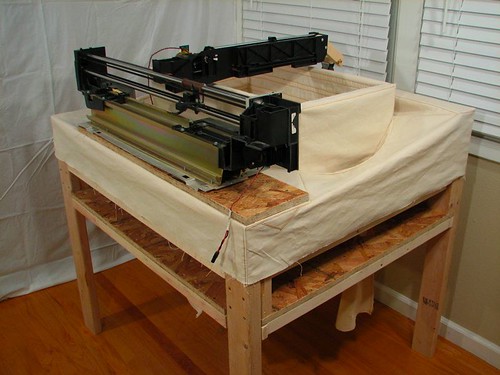
I myself am still drooling a bit over some of the hobbyist CNC stuff. There's a guy in New Mexico who sells these things on eBay. He sells aluminum ones (like this) and ones made of MDF, which I believe is a sort of particle board. Many low-end CNC machines are in the $2000 to $5000 ballpark, whereas he sells these in the $300 to $600 ballpark. It should be pretty easy to swap out that orange router and swap in an extruder.

I was thinking a bit last night about how to drive those steppers, since the offerings on eBay don't include the drive electronics. Digikey sells a stepper motor sequencer chip, the L297, which would be used to drive some power MOSFETs. The L297 just needs an input to choose clockwise or counter-clockwise, and a clock pulse to advance a step in that direction, so you need six GPIO lines to control the three motors, and one more to turn on/off the router or squirt goop out of the extruder. There's some very good information on stepper motors and driver circuits here.

It occurs to me that I've never posted the Sourceforge download page for the RepRap design files. A shocking oversight, given that I want to see the project succeed and proliferate.

Monday, April 21, 2008

Targeted alpha therapy

This is something I read about in 2001, and it still seems to be one of the most promising ideas in cancer therapy. The treatment involves two molecular objects bound together. One is an antibody that gets taken into a cancer cell. The other is a radioactive actinium-255 atom which has a ten-day half-life, and then decays through a few different products, releasing four alpha particles, which rip through the cancer cell and kill it. Luckily alpha particles have only enough energy to destroy one cell, and then they run out of steam and become inert helium nuclei.

At Sloan-Kettering where this work was done, they applied for a patent. A clinical trial was conducted in 2002 with favorable results. There have also been some clinical trials in Australia, I believe.

As far as I am aware, this is a fantastic treatment, due to its being extremely specific, and is applicable to a wide range of cancers, but it's not used much. I would imagine the actinium-255 must be prepared through some process that would probably be very expensive. It would be great if some more affordable alternative could be found. It seems to me that were advanced nanotech available today, some suitable replacement for the radioactive actinium nucleus might be possible.

Nifty stuff over at Machine Phase blog

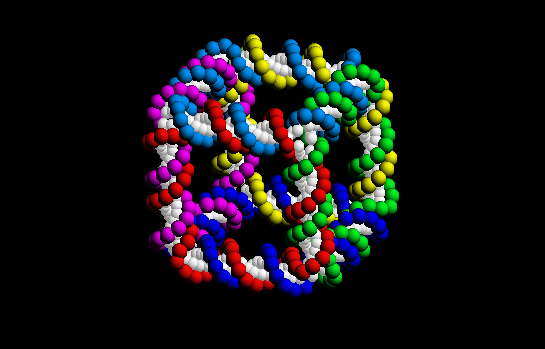
A couple of interesting things from Tom Moore's Machine Phase blog. One is a comparison between a carbon buckyball and a geometrically similar structure made from DNA using (what appears to be) Paul Rothemund's DNA origami technique. Note the teeny dot in the middle, that's the carbon buckytube.

The other is very interesting because it combines nanotech with my interest in 3d printers in an unexpected way. Specifically it's about using a 3d printer to print parts for an atomic-force microscope, using selective laser sintering. These microscopes typically cost hundreds of thousands of dollars. Hopefully this approach will make them much more affordable for universities, and perhaps high schools and even individual hobbyists.

The white plastic pieces were the things printed with the 3d printer. I always thought of SLS as something done with metal, but I guess it works with plastic too.

Wednesday, March 26, 2008

My trip to Munich, 20-25 March 2008

My brother Bob and his wife Anja have been spending a year living in Munich. Bob is in the Air Force reserves and is working at the Air Force base there. Here are my photos from the trip.

For the moment this blog entry is only a placeholder, later I'll fill in more details. The itinerary was roughly as follows. Wednesday night, took a red-eye from Boston to London Heathrow, landing at 6 AM local time and spending six hours learning about unreasonable exchange rates. Then a two hour flight to the Munich airport near Erding where Bob lives and works.

View Larger Map
On Friday we went to the Museum Mensch und Natur (map) in downtown Munich. On Saturday we went to Herrenchiemsee, a palace on an island in the middle of a lake, modeled after Versailles in France. On Sunday we went to the Deutsches Museum (photos, map) in Munich, and I've got to say, it's the best science and technology museum I have ever seen in my life. On Monday we went to the castle complex at Burghausen, on the Austrian border. On Tuesday I was too frantic catching my plane for any interesting adventures, although Bob and I did bike into town to get strawberries and fresh croissants.

Thursday, March 13, 2008

Nanotube radio antenna work at U.C. Berkeley

Alex Zettl at the University of California at Berkeley has invented an interesting radio antenna made from a single conductive carbon nanotube (less than a micron long and ten nanometers wide) positioned between two conductive plates. He has used the antenna to receive songs transmitted by radio, and has posted the results for your listening pleasure. There is a gap between one plate and a free end of the nanotube, across which electrons tunnel. When a voltage is placed across the two plates, the nanotube's free end becomes electrically charged oppositely from the nearby plate, and the electrostatic attraction keeps the nanotube under mechanical tension.

The nanotube's electrically charged free end moves in response to an ambient radio frequency electric field. This changes the gap size, and therefore the measured tunneling current across the gap, just as with a scanning tunneling microscope. The resonant frequency of the antenna is simply the mechanical resonant frequency of the nanotube under tension. The tension can be changed by changing the voltage across the two conducting plates, and in this way the radio can be tuned. The bandwidth of the antenna is determined by the nanotube's stiffness, and (I think) would depend primarily on the length of the nanotube. The space between the two plates should be a vacuum so the nanotube can move freely, and so that Brownian motion does not detune the radio.

The value of a radio antenna this size is that one can communicate with and control nanorobots, for instance in the human body. One could use these nanorobots for diagnostics, reading out blood chemistry or information about various kinds of cell damage, and could send them instructions to intervene.

There are lots of interesting things happening in the area of nanofabrication, such as Andrew Turberfield's tetrahedra discussed in the previous posting. Presently such things are "controlled" by adding solutions of different DNA sequences to the liquid the structure is sitting in, and the new sequence interacts mechanically with the structure to alter it, by binding selectively with some part of the structure already in place. But each step takes tens of minutes as molecules diffuse through water and position themselves to bind correctly. A signal received by a radio antenna might make things happen much quicker.

Thursday, March 06, 2008

Adrian Bowyer interview, Computerworld

Here is the start of the four-page interview. Much of this is stuff that's been published before. Two parts I found interesting appeared on the third page.

Are there plans to modify the current design to replace non-reproducible parts such as bolts with parts that can be manufactured on the machine itself, bringing the overall RepRap design closer to 100 per cent self-reproduction?

Yes - that is definitely one of the evolutionary paths to greater reproductive success. For the immediate future I will be concentrating on widening the list of materials that RepRap can build with (starting with electrical conductors). That widening will implicitly raise the proportion of parts that it can make for itself, of course.

The Fab@Home people have already done a few embedded circuits by printing with conductive silicone. Making circuitry will be a very important ability for these machines.

Can the RepRap recycle what it manufactures?

Yes, recycling has been built in from the start... The main plastic we are using is polylactic acid...

But I want to move to using a non-biodegradable resin. This too is sourced from biomass, but is stable in the ground. That means that the more reprapped goods that get made from it and thrown in landfill, the more carbon is taken out of the atmosphere and locked away for good. And, in 200 years when we have taken so much carbon out of the air to make stuff that anthropogenic global cooling is starting to be a problem, the landfill sites become our strip coal mines to save us.

This is the first time I've ever heard anybody advocate for putting stuff INTO landfills as an environmental measure. An interesting approach to carbon sequestration.

Sunday, March 02, 2008

Coming soon: a complete RepRap kit

BitsFromBytes.com is an on-line store based in the UK which will be offering a complete set of parts for the RepRap for UK£299, or somewhere around US$600 given current exchange rates. They will offer both hardware and software.

I wish I could claim to be so ambitious that I would take a more active approach than simply ordering all the parts in a kit. But I'm as lazy and tired as the next guy, so a kit is really the only practical way I'm likely to do this. And the price is just about right. Months ago, Adrian Bowyer was talking about $400 as a target price for the long term, after lots of self-replicating machines had brought the price of parts down to a minimum. To get so close to the long-term price so quickly is fantastic.

With this kind of head start, the scenario where RepRaps bootstrap themselves to microeconomic ubiquity looks very plausible.

Thursday, February 28, 2008

More service bureaus

In a couple of recent postings I have talked about the Ponoko laser-cutting service. Another very interesting online service bureau is Emachineshop.com which is a machine shop to which you send design files created with their downloadable CAD software. They have some examples of the things people have made. Just poking around their website really makes me drool a little bit. I can't believe I'm not doing something with this.

Big Blue Saw is a service bureau that does waterjet cutting of metal and plastic. They cut very thick pieces of metal, which surprises me, I didn't know you could do that.

A couple more: Fabjectory.com specializes primarily in making physical copies of avatars from games like SecondLife. FluidForms makes pretty flowing shapes for things like vases and pitchers. I haven't read about these yet, and as of this writing I don't know what technology they use, or what design software.

Broadening the definition of "fabber"

I want to broaden the scope of this blog a bit. The word "fabber" is generally accepted as synonymous with "3D printer" but a 3D printer has a lot in common with both CNC machines (routers for wood or milling machines for metal) and laser cutters. There are hobbyists building all of these. All of them make a 2D or 3D shape under computer control with relatively little human intervention, and minimal need for human skill.

How many of these gadgets could be self-replicative in the RepRap sense? For example, could one use a laser cutter (or a laser-cutting service like Ponoko) to cut out pieces and use those pieces to build another laser cutter, thereby driving down the cost of laser cutters? As with RepRap there will inevitably be complicated pieces that can't be made that way. CO2 lasers are dangerous and expensive, so I don't think this could make the kind of impact in the developing world that RepRap hopes to make. A replicating CNC machine might be a better bet, as Dremel tools are much cheaper and safer than lasers.

That self-replicative idea does fascinate me a good deal. It will, over time, drive down the price of the self-replicating thing. That doesn't mean we'll enter a microeconomic paradise, but it promises at least to be interesting and possibly to raise the quality of life noticeably.

I've haven't blogged too much about commercial machines. I want to do more of that. I admire the hobbyists and their perseverance in the face of difficulties, but the technology appearing in commercial machines will gradually trickle down into the hobbyist arena as patents expire.

Wednesday, February 27, 2008

RepRap parts available via Ponoko

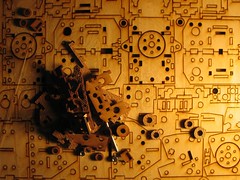
Ponoko is a very cool on-line laser cutter fabrication service with a wide range of available materials. The idea is that you create a EPS file for the laser cutter to follow, specify the material, and they cut out the pieces and ship them to you. The laser can also engrave lines on the material. EPS files can be generated with Adobe Illustrator or various other similar 2D artwork programs. If you want to make a 3D project (like this table), you make it out of 2D pieces that fit together with slots and grooves. When you upload your EPS file and choice of materials, they figure out how much the laser cutting fee will cost.

Toby Borland (of SMARTlab in the U.K.) has designed a set of laser-cut plywood RepRap parts and made the EPS files available on the Ponoko website. There is a Flickr photo set showing laser-cut RepRap parts and the process of assembling them; I am not sure that's the same Ponoko files and process, or another laser-cutting effort, but it gives you a sense of what's involved, and the level of complexity.

Friday, February 22, 2008

Too-brief overview of DNA nanotechnology

cube.gifA lot of interesting work has been done with DNA nanotechnology, much of it starting with Nadrian Seeman's work on DNA polyhedra in the mid-90s (1, 2).

Around 2000, Andrew Turberfield (Oxford University's Department of Physics) used DNA to make tweezers, with arms 7 nanometers long.
"Of course it's all very speculative," said Dr Turberfield, "but you can imagine, for instance, little factories on chips doing chemistry or simple assembly. You can think of production lines made up of little motors with different reactants being passed from one place to the next."
Things got really interesting in March 2006 with Paul Rothemund's DNA origami technique. Here is the publication. I was working at Nanorex at that time, and we were all quite excited about it.

dna_tetrahedron1_256.pngIn 2005 Turberfield and colleagues described a family of DNA tetrahedra consisting of triangles of DNA helices covalently joined at the vertices to form a mechanically rigid 3D structure. This image of a reduced model of one structure, which is less than 10 nanometers on a side, was created using NanoEngineer-1 Alpha 9. The bowing of the DNA helices is pronounced in this rendering and is the result of electrostatic potential terms included in the customized molecular-mechanics-like force field developed by Dr. K. Eric Drexler specifically for DNA structures. Regarding Turberfield's work, New Scientist wrote:
Now Andrew Turberfield [et al] have shown how carefully crafted DNA structures can be made to self assemble and change shape when sent specific DNA signals. The researchers built tetrahedrons ... using four short DNA "struts" that join at each end. The process exploits the way DNA is held together by complementary bases that form the rungs of a ladder-like structure ... the researchers made cages with two extendible struts that could be independently controlled using different DNA sequences. In theory, it should be possible to create cages in which every strut can be controlled independently, Tuberfield says.
These cages are a combination of support material and linear motor, and with the many other DNA tricks being done, they should allow people to build large, complicated, reasonably rigid 3D structures that have controllable moving parts. So this is a very promising development.

A very recent announcement of work by Chad Mirkin and colleagues. They have found a way to use DNA to glue together arbitrary arrangements of teeny gold spheres. People have known for some time now how to make DNA stick to gold spheres, and by careful selection of DNA sequences, Mirkin et al can position groups of spheres in almost any 3D configuration they want.

In light of these developments, Nanorex has narrowed its focus from "general" nanotechnology (anything one might build from common small molecules) to structural DNA nanotechnology. This is likely to be where much progress will occur in the next five years or so. I hope Nanorex will still be around after that, and will be in a good position to shift gears as we move beyond DNA to more general chemistry.

Sunday, February 17, 2008

Those commercial 3D printers sure are gittin' purty

Some commercial 3D printers are very pretty. This one prints in colored plastic and is intended to create prototypes in a few hours that can be shown to managers or customers. The claimed resolution of this thing (presumably in all three dimensions) is 450 dots per inch. Drool.

In twenty years, all the patents for this printer will have expired, and it will be possible for hobbyists to make such pretty stuff at such high resolution. Hmm, thinking more about that inclines me to start an economics blog, since I blog about economics a lot elsewhere.

Friday, February 15, 2008

An XYZ platform for fabbing or CNC

I was watching an auction for a CNC XYZ table on eBay that went for $300, item number 200198037915. I would have bid on it if the Z travel hadn't been only 2 inches. It was built from plans from hobbycnc.com and didn't have stepper motors or the machining tool but was otherwise complete. I felt lust in my heart, but that itty bitty Z travel bugged me, so I thought about what could be done to increase it. Here's my general idea.


My hope is that the blue-hatched stage can be made to take either a Dremel tool for CNC milling, or an extruder for fabbing. The result might or might not be self-replicative in a RepRap sense but it would be a cool toy.

Monday, February 11, 2008

RepRap is now half-way to replication

Vik Olliver has made good progress (1, 2, 3) on the goal of self-replication for the RepRap, having now been able to use a RepRap to fabricate half the RepRap's parts.

It's interesting that you can see the size of the volume pixels Vik is working with. These pieces were printed with polylactic acid, I believe.

Unrelated but cool: Kovio is a non-hobbyist company working on a process to inexpensively print working transistors. Early applications will include smart cards, later you'll see wall-sized displays.


Also unrelated but also cool: Fernando Muñiz has been working with UV-cured resins. This will work a bit like the CandyFab, except the uncured resin is still a liquid so under-support structures are still required. Interesting, I'm not sure if it's better or worse than the FDM approach used by RepRap, Fab@Home, and Tommelise. Also, I don't have any idea how environmentally benign these resins are; it's hard to imagine they're as green as polylactic acid.

Saturday, February 09, 2008

Big fabbers: houses, boats, factories

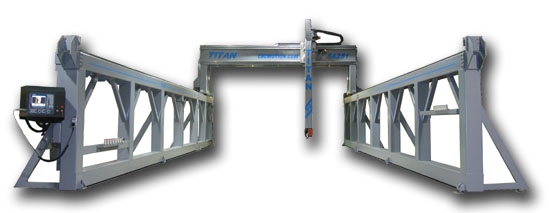
How big could a fabber get? Could a fabber build a boat or a house? Here are two big CNC machines, one of which is claimed to do work on boat hulls.


A fabber placing individual drops of building material would be awfully slow for a very large project. One work-around would be to trade away spatial resolution, and let the fabber lay down big handfuls of wet concrete.

Maybe you'd want many fabbers feeding small pieces to an assembler that assembles them into bigger pieces. The assembler must be able to make the small pieces stick together, by gluing them or melting the sides or by using mechanical fasteners such as screws or nuts and bolts. It's possible that the big pieces might then be assembled into very big pieces, and again an assembling machine must be fed from many sources. The assembler would need to be very smart to recognize and correct assembly errors, and would probably need machine vision. This would work well for products from a factory, but might be unsuitable for a house.

A google search for "robot bricklayer" turns up a few modest research efforts. I would have imagined something like the big XYZ stage above with a brick-lifting robot arm, wheeled into position over the site of the future house, but the most advanced effort visible on the web is a standard industrial robot arm picking up bricks instead of doing whatever else robot arms normally do. The arm can't move around the entire volume of the future house, it's not on any sort of XYZ stage, it's just bolted to the floor like any other industrial robot arm. So robotic house construction is still quite a ways off.

Thursday, February 07, 2008

Fabbers as tissue engineering tools

In late 2006, Gabor Forgacs and other researchers pioneered tissue engineering techniques using 3d printers. This obviously is not a hobbyist application but it's very interesting, and could save thousands of lives. The technique involves alternate layers of "biopaper" and "bioink", the former being a temporary scaffolding gel and the latter being a suspension of adult stem cells.

Tommelise project

Tommelise is Forrest Higg's attempt to build his own RepRap-like gadget before RepRap itself is ready for wide distribution. He has spoken at an O'Reilly conference about the RepRap project and he has some fascinating ideas about architecture and how fabbers might relate to it. The recent (early Feb 2008) postings in his Tommelise blog describe his success in connecting stepper motor axles to threaded rods, something I had been wondering about myself.

In the Tommelise FAQ, Higgs mentions Linux and Java (which have been adopted by the RepRap project) as presenting a steep learning curve to people without a software background, citing Microsoft Windows and Visual Basic as more user-friendly alternatives. My own early experiences with Linux required enormous patience. Higgs writes Tommelise has been created for people who aren't particularly clever and may be living in modest circumstances. Any open-source "fabber revolution" (1, 2, 3) will be an empty exercise if it fails to serve such people. Then again, if a genuinely open-source revolution is to occur, we'll eventually need to wean ourselves from Microsoft and make our own tools equally user-friendly.

Wednesday, February 06, 2008

Interesting Russian project

Here's the website in Russian, and a Google translation to English (click on the "Constructor Kulibin" link). I found this referenced from MAKE Magazine. This is a very interesting project.
They have a great-looking XYZ stage built from a CNC kit. They lower a heating element onto powdered raw material, sintering the raw material as the CandyFab does, except their heating element is a length of nichrome wire instead of a jet of hot air. It gets hot enough to glow, and on the web page they mention that they can work with any powdered material with a melting temperature from 100 to 300 Celsius, including sugar, wax, "Plexi" (plexiglass?), and mixtures such as plastic and sand, plastic and metal powder, powdered paint and sugar powder. Like the CandyFab, each layer of fresh material is laid down on top of the previously worked layer (and I hope that process is automatic as it sounds tedious otherwise) and then you scribble a cross-section on the new layer with the heating element, and then it's time to put down another layer.


The nice thing to this kind of approach is that the unmelted/unfused material provides mechanical support for the built structure. You can build shapes that RepRap and Fab@Home can't make, such as bridges or inverted cones, because any bridge-like part that will go over empty space is built with stuff under it to support it.

This made me curious to start looking around at CNC kits, which could nicely jump-start any fabber project. The XYZ machinery for a fabber is called a "gantry" in CNC language, and there is a very active hobbyist CNC community. Here is a video for a CNC gantry kit that somebody was selling for $195 on eBay. The video itself is for sale ($20) so this is just a teaser.


Here's a few interesting CNC links.

Friday, February 01, 2008

Make Controller Kit

The Make Controller Kit is a pair of boards that snap together, with a AT91SAM7X256 as the microcontroller. For communication it has USB, Ethernet, CAN, and JTAG, and supports the Open Sound Control protocol, which has interfaces for numerous programming and scripting languages. It offers eight analog inputs with 10 bits of precision over a 0-to-3.3-volt range. There are eight high-current digital outputs that can drive relays or two stepper motors or possibly solenoids. There are four servo controllers. It has an 8-position dipswitch. It costs $109 at the on-line store for Make Magazine.

Wednesday, January 30, 2008

CandyFab: The Revolution will be Caramelized

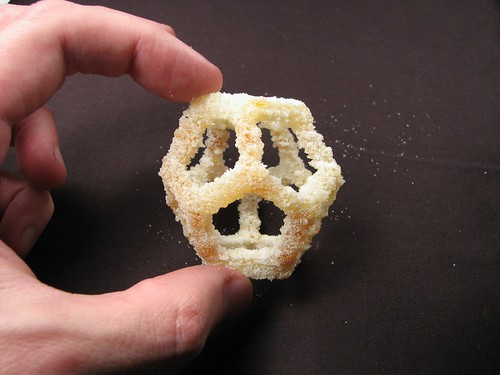
Here's a PDF presentation about the CandyFab, an unusual approach to a hobbyist fabber. These guys decided they could relax their spatial resolution in favor of large volume and cheap fabbing materials. Their fabbing material of choice is sugar, much cheaper than the plastics used by RepRap. Some of the things they make are considerably larger than can be made with RepRap. Here's a Flickr photo set.

In September the CandyFabbers came up with a better hot air nozzle that gives them considerably improved spatial resolution, with volume pixels of about 1/16 inch instead of 1/5 inch.

Some MIT folks have built a fabber that makes stuff out of pasta dough.

Tuesday, January 29, 2008

How does one get started?

How does one start to build one's own fabber? RepRap and Fab@Home both offer instructions. There is of course the caveat that the technology is new and experimental and bleeding-edge, so it's not a shrink-wrapped thing where you simply tear open the packaging and start using it. My goal in this posting is mostly to decide whether it makes sense for me to start work on a fabber. My early conclusion is that I'd like the field to mature a little bit more, but it might be fun to tinker with just the 3-axis motion part (check out the video), probably using this microcontroller board.

The RepRap folks have a page about constructing their version 1.0 fabber, called "Darwin". They recommend that you join the RepRap Research Foundation, which supports new fabber builders, and you can purchase parts from their on-line store.

Fab@Home has a Getting Started page with links to their catalog and the list of materials that you can fab with. A pre-assembled Fab@Home fabber will set you back about $3600 plus shipping, currently with a 6-to-8 week lead time, so I guess people are buying them. The Fab@Home is an impressive thing, and good looking.

Hobbyist fabbers today look the way Linux did in 1993. In five or ten years fabbers will be much more common and much more polished, but the people tinkering today will have 99% of the fun. Linux in 1993 was not at all user friendly, everything needed to be hand-tweaked, and you needed to understand a lot of it to use any of it, and the same was true with cars in 1910, and with fabbers now.

Brilliant RepRap video (thanks to Emeka Okafor)

I am deeply indebted to Emeka Okafor, author of the Timbuktu Chronicles blog and director for the TEDGlobal 2007 conference in Tanzania, for stumbling across this brilliant Poptech video of Professor Adrian Bowyer, the inventor of the RepRap fabber. I would also like to thank Mr. Okafor for giving attribution to my nanotechnology blog, and call attention to his postings on technologies that can help Africa and other developing regions. There is an Emeka Okafor who plays basketball, I'm not sure if it's the same guy.


Bowyer talks about the economics behind the project, particularly its ability to empower communities that are now economically depressed. There is some yummy game-theory stuff in the paper linked here that does not get mentioned in the video, check it out. He also talks about using polylactic acid (wikipedia) as a printing material for the RepRap. This is significant because you can make PLA from starchy vegetables like potatoes and corn, and when you're finished using your PLA object, you can compost it to help grow next year's crop of starchy vegetables. You can have a closed-loop local manufacturing economy that doesn't require trucks or trains or ships to move products around. In fact there are several materials under consideration, and thought has been given to printing a single product from multiple materials. The Fab@Home folks also have an impressive list of materials that can be fabbed, including chocolate.

I got curious about PLA and did a little googling. In a RepRap forum there is a discussion of just how easy it is to turn starchy vegetables into PLA. From the sound of it, it is non-trivial and demands that the person attempting it be quite knowledgeable. One person compares "home PLA production today to home biodesiel production 20 years ago, when it was arcane, a little dangerous, and rare, but theoretically possible" and notes that for many people it will simply not be economical compared to mail-ordering some PLA. I found a place that sells utensils, plates, and cups made from PLA. NatureWorks appears to be a source for PLA in ready-to-work form.

3D printer in a knick-knack store

Make Magazine has a note about an Umbra concept store in Toronto which now has a 3D printer (some people also call them "fabbers"). The store can use it to fabricate novel items, and the store chain designers visit the store to create and fabricate designs while chatting with customers about the process. The little white widgets to the left of the printer are some of its products.


I'm interested in 3D printers, but I haven't dedicated the time to build my own, as some people have started to do. It's intriguing to imagine what 3D printers might accomplish in combination with automated design techniques such as genetic algorithms (here are some more GA links).

At the present time, 3D printers are the closest things to real nanofactories, and they present limited versions of many of the same challenges that nanofactories will bring, such as copyright issues and the bumpy ride toward a post-scarcity economy.

Monday, January 28, 2008

Starting a fabber blog

Lately I've been thinking and posting a bit about fabbers (also called 3D printers), primarily on my nanotechnology blog. I think the topic (and my growing interest in it) is rich enough to deserve its own blog. I am particularly interested in affordable hobbyist fabber projects, something I might be able to fool around with myself.

The fabber idea is pretty simple. Take a hot glue gun and three stepper motors. Use the stepper motors under computer control (with appropriate mechanics) to position the hot glue gun at a specific XYZ point, and deposit a drop of hot glue. The glue cools and you move to the next XYZ point. Use this arrangement to draw a glue pattern on a horizontal surface, then move up a little bit and draw the next layer, and then the next. Soon you've got a 3D object of almost any shape you wish. A few of the details can vary -- it's not really glue, it's typically a polymer like polylactic acid -- but that's the basic idea.

There are professional and industrial fabbers with prices starting at about $50,000. But more interestingly, there are hobbyist projects to build much more affordable fabbers. The two currently prominent hobbyist efforts are the RepRap project (wikipedia entry) started by Adrian Bowyer at the University of Bath in the UK and the Fab@Home project started by Hod Lipson at Cornell. There are others but these two have the highest visibility and, as far as I can tell, the largest numbers of participants.

The Fab@Home fabber looks more polished than the RepRap, but I find the RepRap more interesting. Partly because it's more affordable (a getting-starting price somewhere around $400 versus $2300) but also because Bowyer is more committed to an open-source approach and is more interested in the implications of that approach. He very intentionally designed a machine that could fabricate most of its own parts and could therefore mostly copy itself. If the machine becomes popular, its price will quickly drop (building one today might cost a good deal more than $400 and a very large investment of tinkering time) to roughly the price of the few non-copyable parts and the raw plastic for the rest.

Sunday, January 27, 2008

Videos and links, RepRap and Fab@Home

Since I've been writing a lot about fabbers lately, I've decided to start a fabber blog and start migrating my fabber postings over to it, starting with this one. Fabbers are only peripherally related to advanced nanotechnology (the economics look similar) and I'd like the fabber blog to go into a level of detail that's not appropriate here.

As far as economic similarities, a fabber looks a lot like a crude nanofactory, and raises many of the same societal concerns but in a smaller, safer way. One of the popular speculations about mature nanotechnology goes like this: (1) sufficiently advanced nanofactories will be able to make almost any desired product from materials found in nature, so (2) the price of physical goods drops to nearly zero, and then (3) money ceases to exist and we all live in a post-scarcity society free of poverty, disease, and war.

It's an appealing simple notion, probably too simple. Even when the necessities of life are available essentially for free, humans always envy other humans and there will still be a premium to pay for things beyond the survival level. Economic demand will exist as long as we're still human, and money will too. Besides, physical goods aren't the only things we spend money on. I can imagine a robot bus driver at some future time, but a robot doctor seems a long way off, and it's hard to imagine the board of directors that will appoint the first robot CEO.

Tuesday, January 01, 2008

Xilinx Spartan 3 FPGA eval board

I was thinking I wanted to do something with the ARM91SAM7 eval board and a Xilinx FPGA, and I discovered that Xilinx also sells a eval board for their Spartan-3 FPGAs for $150. Here's the user guide (PDF). Big surprise, it's available at Digikey.

The Spartan-3 series has hardware multipliers, blocks of RAM, and "distributed RAM bits" which you can spread around your design as needed. Pretty sweet. As I mentioned in an earlier posting, there are readily available HDL tools for FPGA design on a Linux platform. Hardware design shouldn't necessitate the indignities of Windows.

Here is a ridiculously affordable SAM7 board that I need to investigate. It lacks RS-232 level converters, and you need to kludge the JTAG stuff (probably drive it with a parallel port somehow or other). Also interesting are these two open-source simulators for the ARM7 architecture.

The idea would be to use the SAM7 eval board to program the FPGA on the Spartan-3 eval board. FPGA programs are pretty large, so maybe this should be done by feeding the bits through the USB cable. Then you have some GPIO bits on the SAM7 connect to IO pins on the FPGA, and other IO pins on the FPGA to the outside world.

Some years ago, there was a guy who got his hands on some prototyping hardware of this sort (PowerPC based, I think I recall) and he set up a paid-subscription website where subscribers could submit compiled code and run it on his hardware. The cost of a subscription was small compared to the price of buying one's own hardware. According to EE Times Asia, Hitachi was doing the same thing in 2002.
Hitachi Semiconductor America Inc. is trying to move remote engineering to the next level by letting customers tinker with microcontroller hardware and software tools via a Web browser.

Working with DevelopOnline, Hitachi has set up several remote development stations for its H8 microcontroller family. For a fee, engineers can access these remote engineering laboratories from a PC at any time. Hitachi launched the service with its H8/3664 microcontroller device and plans to expand the program during the next several months to include other members of the H8 line and the company's SuperH devices.
One could make two of these gadgets and connect one to an Apache box to set up a remote development website like this. The second gadget is used to tweak/observe GPIO pins, interact with serial debug, etc. There would need to be some mechanism for allocating time fairly among multiple subscribers. The website would want lots of example code (or pointers to code findable on the web) for people to get started.

Thursday, December 27, 2007

AT91SAM7S microcontroller and eval board

Recently I came across the AT91SAM7S microcontroller from Atmel (Wikipedia article). It's a very cool gadget and is affordably available at Digikey. Here is Atmel's ad copy:
The AT91SAM7SE512 is a Flash microcontroller with external memory bus based on the 32-bit ARM7TDMI RISC processor. It features 512K bytes of embedded high-speed Flash with sector lock capabilities and a security bit, and 32K bytes of SRAM. The integrated proprietary SAM-BA Boot Assistant enables in-system programming of the embedded Flash. The external bus interface supports SDRAM and static memories including CompactFlash and ECC-enabled NAND Flash.

Its extensive peripheral set includes a USB 2.0 Full Speed Device Port, USARTs, SPI, SSC, TWI and an 8-channel 10-bit ADC. Its Peripheral DMA Controller channels eliminate processor bottlenecks during peripheral-to-memory transfers. Its System Controller manages interrupts, clocks, power, time, debug and reset, significantly reducing the external chip count and minimizing power consumption.

In industrial temperature worst-case conditions, the maximum clock frequency is 48MHz. Typical core supply is 1.8V, I/Os are supplied at 1.8V or 3.3V. An integrated voltage regulator permits single supply at 3.3V. The AT91SAM7SE512 is supplied in a 128-lead LQFP Green Package, or a 144-ball LFBGA Green Package. It is supported by an Evaluation Board and extensive application development tools.

The AT91SAM7SE512 is a general-purpose microcontroller, particularly suited to applications requiring high performance, USB connectivity and extended on- and off-chip memory.
So that's already pretty cool, but even better, there is a great little evaluation board which is also available at Digikey. Software resources abound.

Thursday, December 20, 2007

Other great nanotech (and related) blogs

I guess if I say "other great" nanotech blogs, the implication is that my blog is itself great, but many of these listed are much better than mine. The people doing them put in more work and more thought. Not all of these are relevant to long-term nanotech, but anyway here's the list.
  • Tom Moore's Machine Phase blog -- Tom is now working for Nanorex, and doing a lot of pretty, brilliant nanomachine design work.
  • Damian Allis's Somewhereville blog -- Damian is Nanorex's consulting quantum chemist, and a fascinating guy in general. He doesn't play a scientist on TV, he's an actual real scientist.
  • Gina "Nanogirl" Miller's blog needs no introduction for those who've been around nanotech discussions for a while
  • Blog of the Center for Responsible Nanotechnology
  • Howard Lovy's NanoBot blog
  • Foresight Institute's Nanodot blog
  • Rocky Rawstern's blog
  • A list of nanotech blogs
  • An explanatory website (not a blog per se) by one of the authors of "Nanotechnology for Dummies"
  • A blog about nanocrystals, though I'm not sure what differentiates a nanocrystal from any other crystal
  • The Singularity Institute is primarily about artificial intelligence rather than nanotechnology but there is a lot of common ground.
  • The IEEE has an automation blog about present-day industrial robots.
  • Another present-day robot blog, this one with more of a hobbyist spin.
  • Emeka Okafor's Timbuktu Chronicles blog is not about nanotechnology or robotics, it's about technologies that help and empower people in developing regions of the world. When not blogging, Okafor sometimes plays basketball, unless it's another guy with the same name.

Tuesday, December 11, 2007

The Roadmap Report is published!

The report is now available in PDF format. If you are a Digg subscriber, PLEASE vote up the digg story about it so it reaches the front page. Publicizing the report is a step toward a rational and benign development policy for advanced nanotechnology. I have the privilege of knowing a few of the people who've been involved with the Roadmap project, and they are the kind of people you hope will be involved: very bright, and very ethical.

I haven't gotten far in reading the report yet myself. It's rather thick, in two sections of about 200 pages each. Don't be put off by that, as the language is quite accessible, even in the more technical second half.

Monday, October 22, 2007

Brilliant collection of hobby electronics videos

http://dev.emcelettronica.com/ETUBE

This is a collection of YouTube videos about different topics in hobby electronics. I've only just discovered this and haven't yet checked out many of the videos, but it's great to see that so many have been posted. It seems to mostly be two guys working for Make Magazine.

Thursday, October 18, 2007

It's a good time to be an electronics hobbyist

OurPCB is a Chinese PCB fab outfit with an initial cost of $57.00 and a subsequent charge of around 15 to 25 cents per square inch for 2-layer boards and 50 to 75 cents per square inch for 4-layer boards. The per-square-inch costs shrink for bigger orders. So PCB fab and assembly is cheap. What do I do with this? Obviously there is a huge opportunity to do something.

PCBs and assembly (even surface mount assembly) are no longer a significant obstacle to complex electronic projects. The next obstacle is that I'm lazy about learning. To some extent that can be addressed by prioritizing what to learn - if USB does all the communication I need, I can ignore PCI.

We could have an electronics hobbyist renaissance as good as the 1970s, starting with a series of articles in Make magazine. O'Reilly would probably love it.

The economics works better for big boards than for small boards. I can envision scalable VLIW array processors spanning several FPGAs, or maybe tightly networked DSPs or GPUs. I like the look of the Analog Devices ADSP-31362. I could review some of the molecular modeling code out there (Amber, CHARMM, Gamess, Gaussian, Gromacs, NAMD) and build an scalable architecture optimized for molecular modeling, large-scale simulations, and other interesting things.

Building a supercomputer, that's so unimaginative. I don't have any interesting problems to feed it. I suppose I could build it and let other hobbyists figure out what problems to throw at it.

Wednesday, October 17, 2007

Some of the code for the board

Much of this code was written by a genius named Wolfgang Wieser, who deserves the Nobel Prize in hobbyist electronics. I've tweaked his code in places.

The firmware is at http://will.ware.googlepages.com/fx2_firmware.tgz and the Eagle design files are at http://will.ware.googlepages.com/n1ibt_board.tgz.

I work in Linux, and the stuff in these tarballs is written to work on a Linux box. To build the firmware you'll need SDCC on your machine. I've built the firmware successfully on Mandriva 2006 and Fedora Core 5. I have had trouble getting it to work on Ubuntu and hope to get that fixed because I'm migrating my home machines to Ubuntu.

Verilog/FPGA tools for Linux

Until I get more organized with this, it's just a collection of random links. I'll need to figure out a way to program the FPGA on my board.Go to the Xilinx web page for downloading WebPACK and grab a free download. It's a shell script; run it to install the Xilinx tools on your hard disk. It will take about a gigabyte so make sure to install it in a partition with that much room. Start reading doc/usenglish/books/docs/qst/qst.pdf. That's as far as I've gotten today.

Good Verilog tutorial here.

More about the board -- progress stalled, hoping to pick it up again

Periodically people email me and ask how things are going with my SDR board. Things are quite thoroughly stalled. I can program the FX2 over the USB cable, and I can wiggle the I/O pins, and I've connected the I/O pins to the FPGA's JTAG programming pins. Theoretically it should be pretty easy to program the FPGA after that. But that's where it is stalled; for some reason the FPGA won't program correctly. Go figure.

One thought is to make up a board with a lot more testpoints, like this.

This design is for a temporary two-layer board that I would use only to get the design and development effort back on track. Once I'd resolved the FPGA programming issues, I'd go back to a four-layer design with a lot fewer testpoints.

But if you're one of those impatient folks who wants to play with a software-defined radio RIGHT NOW then you should check out these links, many of which describe projects that are much further along than my board.

The software-defined radio board (an old post)

Two years after my first attempt, I am working on a new board for software-defined radio. In the past, I pursued this as a political agenda, but that made me rush, and ultimately design a crummy board that didn't work. I've split the design into two pieces and this board is the first piece. It has an 8-bit processor with USB slave capability, and it has a Xilinx XC3S400 FPGA with 400K gates, lots of on-chip RAM, and 16 hardware multipliers, each 18-bit by 18-bit. The USB channel can get data to or from your laptop at over 50 megabytes per second. The board has 46 general purpose I/O pins and six dedicated pins. Not counting assembly, which you can do cheaply at home, the board costs about $70, so it's a pretty good deal for a hobbyist.

The second piece of the radio is a board with fast digital-to-analog and analog-to-digital converters, to translate the signals between the digital domain and the world of radio electronics. A receiver would use an ADC, a transmitter would use a DAC. I'd like to design a receiver board first, but I want to get the USB/FPGA board up and running before that.

If you had this thing connected to your laptop, you'd install GNU Radio and you could transmit and receive radio signals. Depending on the analog hardware you had, you could do this on any of several radio bands, and with the USB bandwidth and a fast ADC, you could pull in whole television signals, maybe even HDTV signals. And that's when things get interesting politically, because that's the battleground for fighting the Broadcast Flag battle.

The USB/FPGA board is a remarkable example of what a low-budget electronics hobbyist can do these days. A couple years ago I spent some money on a license for CadSoft Eagle to do four-layer boards but I expect it to fill my hobbyist needs for a long time. Now I can send my Gerber files to PCB fab outfits in China like this one and get boards for ridiculously low prices. As a result, my electronics projects cost very little more than the price of the parts. It's cool, and it calls for a renaissance of electronics hobby activity. To us oldtimers it seemed like the 1970s was the peak for that kind of thing, but it can come back stronger than ever.

Monday, October 01, 2007

Things are a little different for Ubuntu

On an Ubuntu box I needed to change my 1xEVDO files. Now /etc/ppp/peers/1xevdo look like this.
-detach
ttyACM0
115200
debug
noauth
defaultroute
usepeerdns
connect-delay 10000
user 5089547611@vzw3g.com
show-password
crtscts
lock
lcp-echo-failure 4
lcp-echo-interval 65535
connect '/usr/sbin/chat -v -t3 -f /etc/ppp/peers/1xevdo_chat'
And /etc/ppp/peers/1xevdo_chat looks like this.
TIMEOUT 10
ABORT 'NO CARRIER'
ABORT 'BUSY'
ABORT 'NO DIALTONE'
ABORT 'NO ANSWER'
ABORT 'ERROR'
SAY 'Starting CDMA modem script\n'
'' 'ATZ'
'OK' 'ATE0V1'
OK-AT-OK 'ATDT#777'
CONNECT \d\c
That seems to do the trick. This stuff was cribbed from an article at Linux.com. It seems to work a good bit better, actually, so I should probably try this on the FC5 box as well.

Friday, September 28, 2007

Verizon phone as cellular modem

In a week or two I will be traveling. There will probably be Verizon coverage but there won't be conventional internet access. So I picked up a USB data cable for my LG VX8300 and added Verizon's BroadbandAccess connectivity to my account for a month. I'm a big Linux snob, so I needed to dig around for relevant Linux info. I found everything I needed on KA9Q's web page on the subject.

On Fedora Core 5, I needed to set up three files:
  • /etc/ppp/peers/1xevdo
  • /etc/ppp/peers/1xevdo_chat
  • /etc/ppp/pap-secrets
  • /etc/resolv.conf # use known-good nameservers
and then run
pppd call 1xevdo
as root. Within a few seconds, you should see a valid IP address when you type
ifconfig ppp0
and you're online. It's the coolest thing. Considerably slower than the wireless service at Starbucks or Panera but it's a lot better than no connectivity at all.

Tuesday, September 11, 2007

The Roadmap conference is coming up

A couple years ago, Foresight, Battelle, the Society of Manufacturing Engineers and a few other organizations put together a project called the Technology Roadmap for Productive Nanosystems. The idea was to figure out the steps that would lead us to a world of safe and mature nanotechnology. I know some of the people involved in this effort. They've had meetings to which I've not been invited, which is appropriate because they have important work to do, and they don't want the distraction of answering questions from the idly curious.

Their work has percolated along for about two years (that I've been aware of, probably more time before that) and finally there will be a conference where they will tell the world what they've been up to. As luck would have it, I have a schedule conflict and will be unable to attend, but there will be a CDROM of the presentations and I hope to ask around and see if I can get a copy.

I have high hopes for the work these people have done. This is a well-organized effort by a lot of very smart people with a wide range of relevant expertise.

The Center for Responsible Nanotechnology website discusses the societal risk of multiple competing nanotechnology development efforts:
The existence of multiple programs to develop molecular manufacturing greatly increases some of the risks listed above. Each program provides a separate opportunity for the technology to be stolen or otherwise released from restriction. Each nation with an independent program is potentially a separate player in a nanotech arms race. The reduced opportunity for control may make restrictions harder to enforce, but this may lead to greater efforts to impose harsher restrictions. Reduced control also makes it less likely that a non-disruptive economic solution can develop.
A unified effort like the Technology Roadmap initiative represents a safeguard against these very realistic concerns.

Tuesday, August 21, 2007

Software-defined radio board: Stalled, for now

Periodically people email me and ask how things are going with my SDR board. Things are quite thoroughly stalled. I can program the FX2 over the USB cable, and I can wiggle the I/O pins, and I've connected the I/O pins to the FPGA's JTAG programming pins. Theoretically it should be pretty easy to program the FPGA after that. But that's where it is stalled; for some reason the FPGA won't program correctly. Go figure.

One thought is to make up a board with a lot more testpoints, like this.
I had a picture of a board design here before, but I think I've since misplaced that file. I'll try to remember to check around for it.
This design is for a temporary two-layer board that I would use only to get the design and development effort back on track. Once I'd resolved the FPGA programming issues, I'd go back to a four-layer design with a lot fewer testpoints.

But if you're one of those impatient folks who wants to play with a software-defined radio RIGHT NOW then you should check out these links, many of which describe projects that are much further along than my board.

Monday, July 02, 2007

Linear least square error estimation

Let z be some unknown function of x and y. Assume the function is close to linear, so we want a function
    f(x,y) = a x + b y + c
that approximates z by minimizing the total square error for a collection of N data points (xi, yi, zi). We will need to accumulate the following sums. This can be done incrementally in real time, if the data arrive that way. We can use exponentially weighted sums to give more importance to more recent data points, if that makes sense.
Sx = ∑ xi
Sy = ∑i yi
Sz = ∑i zi
Sxx = ∑i xi2
Syy = ∑i yi2
Sxy = ∑i xiyi
Syz = ∑i yizi
N = ∑i 1 (or with exponential weighting if desired)
Then we have a total square error:
    E = ∑i (zi - axi - byi -c)2
and we want to minimize that error by choosing (a,b,c) at a minimum:
    ∂E/∂a = ∂E/∂b = ∂E/∂c = 0

0 = Sxz - a Sxx - b Sxy - c Sx
0 = Syz - a Sxy - b Syy - c Sy
0 = Sz - a Sx - b Sy - cN
Then we can obtain (a,b,c) from linear algebra.
[ a ]    [ Sxx Sxy Sx ]-1  [ Sxz ]
[ b ] = [ Sxy Syy Sy ] [ Syz ]
[ c ] [ Sx Sxy N ] [ Sz ]
Based on all this, we can write a linear least-squares estimator class in Python.

Recent tech talk at Google: Aubrey de Grey

This is a Google Tech Talk by Aubrey de Grey, who has studied gerontology at Cambridge University. He has thought about ageing as a problem with an engineering solution. He has charted the course of the solution in broad strokes, and put together a credible plan to make good progress over the coming decades, with ideas about which science to pursue and how much money would be needed.

My health is good but not stellar and like many Americans, I'm overweight. I ordinarily assume that as my 50th birthday fast approaches, I've got 25 or 30 years left. That's how I try to plan my finances and other aspects of my life.

In this talk de Grey presents what he calls conservative estimates of what would be possible if we were to pursue his research program. If he's right, I've got a good shot at not just a few more decades of life, but perhaps a few more centuries, conceivably a lot more centuries.

I fear death as much as any normal person. Perhaps if I had more time, more youth, more energy, I could make some more important contribution to humanity than I've made. Certainly I have the selfish wish to have more freedom, travel more, make more money, play with more toys, read more books, have more sex, all that stuff.